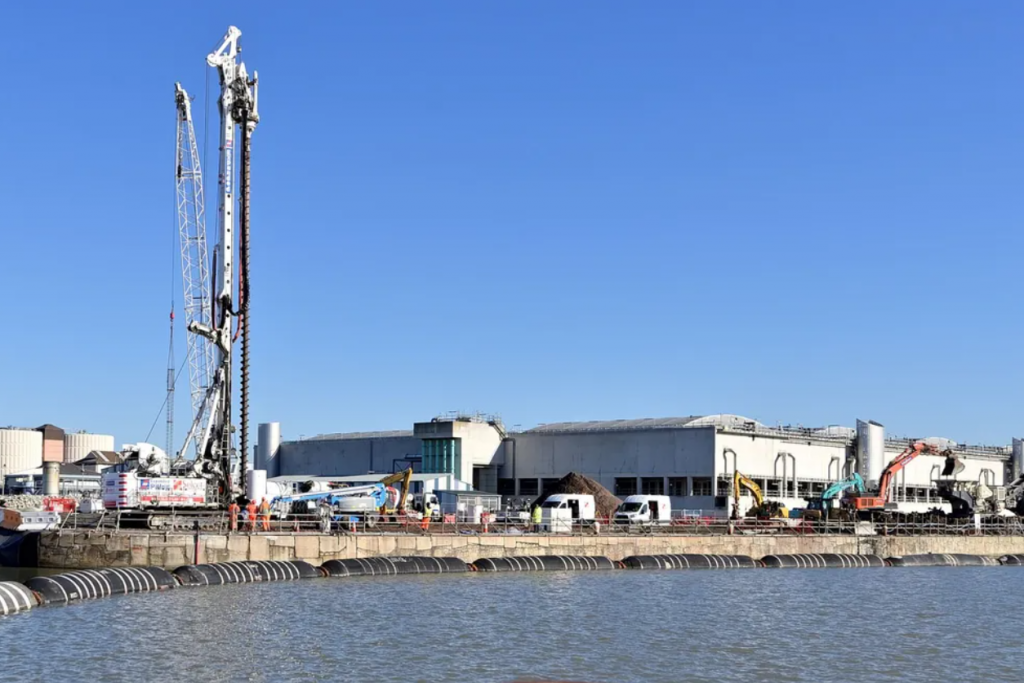
The process will take around three months to complete

Main contractor Laing O’Rourke is overseeing the installation of 2,500 concrete piles for the foundations of Everton FC’s new 52,888-capacity stadium at Bramley-Moore Dock.

Table of Contents

The piling work, which began this week, is expected to continue until next summer. This will include foundations for the western stepped terrace that will overlook the River Mersey, Liverpool.

Infilling of the Grade II-listed, 10m deep Bramley-Moore Dock with more than 450,000m3 of fluidised sand began at the start of October. The process, aiming to provide a solid base across the site, will take around three months to complete.

The piling work is expected to continue until next summer

Providing a solid base across the site will take around three months to complete.

Infilling of the Grade II-listed, 10m deep Bramley-Moore Dock with more than 450,000m3 of fluidised sand began at the start of October. The process, aiming to provide a solid base across the site, will take around three months to complete.

While the infilling continues, foundation work has initially started on the north and south stands, where all the heritage assets have been removed and, where possible, are being preserved.

Danny Jones, part of the team overseeing the piling for the club’s construction partner Laing O’Rourke, explained: “We drill down to around 16m with a hollow drill, and, as we go, we pump concrete to the bottom through the stem to replace the bore with a column of concrete.

“We then place a reinforcement cage inside the bore, and this will form the foundations for the stands.

“In total, we expect to bore around 2,500 piles, each one being 600mm diameter and the deepest pile being 18m.

“They take around 4-6m3 of concrete per pile and, depending on the progress of the dock, we anticipate this work to be complete by the middle of next year.”

Designed to avoid the dock walls to prevent any damage to the listed assets

The piling layout is designed to avoid the dock walls to prevent any damage to the listed assets and to preserve them. Should the club decide to move the stadium in the distant future, it said the site could be reverse-engineered back into a dock.

The dock infilling will create a compacted and rolled surface, using sand dredged from the Liverpool Bay and the Irish Sea. This solid base will then be suitable for more piling, which will begin early next year and will form the substructure of the new stadium.

Historic England was against the infilling of the dock, as it believed it would “fundamentally change its historic character” and there was “lack of evidence” that it was necessary.

Liverpool City Council’s planning committee, however, approved the plans in February submitted by Everton Stadium Development, a subsidiary of Everton FC.

Largest single-site private sector development currently under construction in the UK.

The stadium development in Liverpool’s Northern Docks is recognised as the largest single-site private sector development currently under construction in the UK.


Related Articles you may like

Building Control Consultant
How a Building Control Consultant Helps Your Project Succeed

When you’re building anything from a small extension to a full development, staying on the right side of the rules makes a big difference, and that’s where we come in. We work with self-builders, architects and developers to make sure building regulations are followed from the start. That means giving clear advice, checking your plans, and helping you avoid costly mistakes. Because we know how different councils work across the UK, we can spot local issues early. Our goal is to keep your build safe, legal and on track, so you can spend more time building and less time fixing problems.

Read More »
Air Testing UK
Certified Air Pressure Testing UK Helps Keep Homes Airtight

We get asked all the time what air pressure testing is and why it’s needed, so here’s the easy answer: it checks how much air leaks from your building. Too many gaps make your home cold and expensive to heat, and it can even stop you from passing building regulations. We use special fans and equipment to find where the leaks are, then help you fix them if needed. The test helps with your energy rating too, which means lower bills and a warmer home. At Ratio Seven, we make the whole thing simple from start to finish and guide you every step.

Read More »
Airtightness Solutions for Challenging Architectural Designs

Ensuring airtightness in challenging architectural designs is crucial for enhancing energy efficiency, moisture control, and indoor air quality. When dealing with complex structures such as irregular shapes, multiple storeys, extensive glass usage, and intricate detailing, you must implement innovative solutions to manage air leakage effectively. Ratio Seven employs advanced air sealing techniques, thermal imaging, and pressure testing, as well as specialised materials like airtight membranes and high-performance insulation. By integrating airtightness considerations early in the design phase, maintaining rigorous quality control during construction, and conducting thorough post-construction testing, you can achieve superior airtightness without compromising the aesthetics or functionality of your building.

Read More »