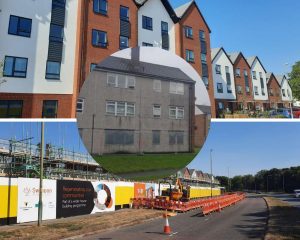
That means the issue of housing quality is now critical, particularly given the government’s aim to get 300,000 new homes built every year by the mid-2020s. But despite new planning guidance, billions being poured into financial support for housebuilding and land supply and growing political and public pressure over the shameful growth in homelessness. This government is no nearer to working out how to build enough good quality, affordable homes that will adapt to people’s changing needs.
Ipsos Mori research for the Royal Institute of British Architects found that people prefer Victorian and Georgian homes that feel more spacious, light and flexible. While Riba’s Future Homes Commission pointed out how poky many British homes are by European standards. Living space, storage, noise insulation and natural light are routinely in short supply.
British home design is not keeping pace with our fast-changing lives
British home design is not keeping pace with our fast-changing lives and expanding and contracting family groups; from single-parent families to home working and elderly relatives with limited mobility.
Recognising the problem of quality, the government set up the Building Better, Building Beautiful Commission. This lacks a permanent chair after the sacking of Sir Roger Scruton. It aims to improve the design of homes, villages, towns and high streets. This needs to explore ways in which communities can be encouraged to embrace new development rather than oppose it.
Scruton had been a strong critic of modern architects, such as Richard Rogers and Norman Foster. Thus leading to suspicions that the commission could end up rehashing stale arguments around the relative virtues of modern and classical design while saying little of value. Perhaps Scruton’s exit has opened up space for more constructive debates.
The risk is that the understandable desire to tackle the excrescences appearing across the countryside. This, in turn, will focus too much of the commission’s attention on assuaging the concerns of middle England shire town residents in terms of what looks good, and lose sight of the far more important issue of what works well.
Create communities as well as new homes
Building beautiful should mean creating communities that enhance residents’ physical and mental wellbeing. This includes integrating with public transport, work and leisure opportunities and the existing community, as well as meeting a range of needs. It also means providing a diversity of design and use in a way that still exploits the cost and environmental benefits of standardised construction techniques.
Good ideas abound on creative ways to build homes and communities. A contribution to the commission from a group of architects fronted by Lib Dem peer Matthew Taylor shows how traditional ideas can be reinvented. Among many examples, it shows how inspiration can be taken from the clustering and design of farmhouse buildings to provide 21st-century homes in a windswept rural landscape, how to bring green space into high-density housing and how to reclaim streets from cars. It was at the launch of this report that Malthouse predicted the rapid demolition of much of the current wave of new housing.
But the omens from the government are not good. From unimaginative interpretations of what constitutes a beautiful building to the erosion of development rules, the fear must be that, just as the pressure is on to ramp up construction, ministers fall back on outdated design concepts and a misguided belief in deregulation that further empowers developers at the expense of communities.
Malthouse has grasped the problem. He must now look beyond appeasing middle England and developers to deliver a solution of courage and imagination.
Read the full article from The Guardian here.